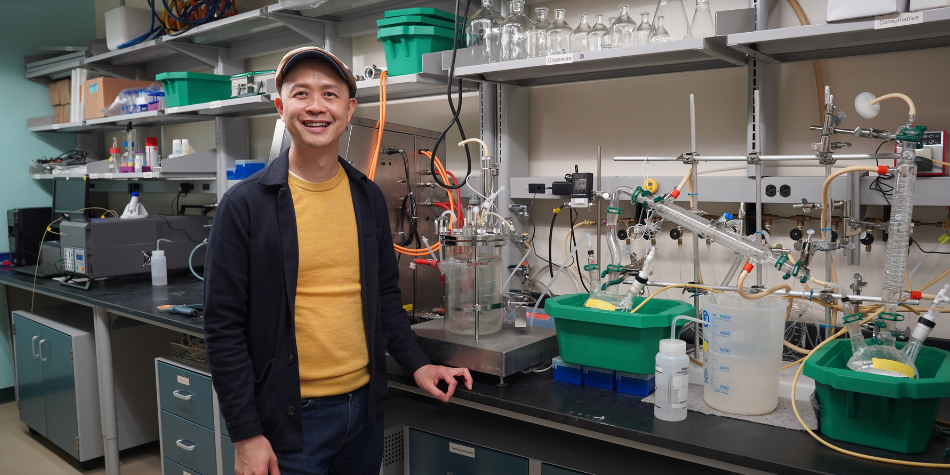
With support from the University of Tennessee Research Foundation, Cong Trinh, Ph.D. is developing a scalable biomanufacturing platform that could help industries produce high-value industrial chemicals from renewable resources instead of petroleum.
A professor of chemical engineering and Ferguson Faculty Fellow in the Tickle College of Engineering at UT Knoxville, Trinh is engineering programmable microbial “cell factories” that transform agricultural feedstocks into high-value chemicals. Through their startup, Estersol, Trinh, and his collaborators are working to bring the technology from the research lab to the marketplace.
At the center of Estersol’s initial commercialization efforts is butyl acetate, a naturally occurring ester found in fruits such as strawberries, apples and pears. The flavors and smells of many fruits result from ester compounds. Esters are also widely used across industries that shape everyday products, including cosmetics, pharmaceuticals, paints, coatings and microelectronics manufacturing.
Today, most esters, including butyl acetate, are produced through petroleum-based chemical refining. These processes can be energy-and carbon-intensive while also introducing trace metal impurities that pose challenges for industries requiring sustainable, high-purity ingredients.
Trinh’s work aims to provide a renewable alternative.
Reprogramming Microorganisms to Manufacture Chemicals
Trinh’s patented technology uses genetically engineered bacterial cells as programmable “cell factories” that convert plant-based materials into useful chemicals through fermentation, a process in which microorganisms consume sugars and convert them into new molecules. By modifying the cells’ biological pathways, Trinh’s team can program the microorganisms to produce different target molecules.
“We program the cells with enzymatic steps so they can convert raw materials into the molecule we want,” Trinh said.
In Trinh’s process, agricultural materials and other biomass sources are processed into sugar-rich feedstocks that engineered cells consume and convert into products such as butyl acetate. The approach is designed to support scalable, renewable chemical manufacturing with lower reliance on petroleum-based inputs.
Much of the work has focused on corn and corn stover – the leftover stalks, leaves and other agricultural residue left after corn harvest – because of their availability in Tennessee. However, the platform is designed to work with a wide range of renewable feedstocks.
“If you’ve got the feedstock supply in your backyard and the customers nearby, that’s the best way to start a business,” Trinh said.
Existing agricultural and fermentation infrastructure in Tennessee could support the commercialization of the technology by supplying feedstocks, processing capacity and distribution networks close to potential manufacturing sites.
According to Trinh, the fermentation process is similar to, and in some ways simpler than traditional corn ethanol production, allowing the technology to leverage infrastructure already used in large-scale fermentation industries.
“One of the advantages is that we don’t have to invent everything new,” Trinh said. “We can use existing infrastructure.”
Building a Platform, Not Just a Product
Butyl acetate is only the first target molecule in what Trinh sees as a much larger opportunity for bio-based ester manufacturing.
“We call it a modular cell design platform,” he said. “You can put in different modules and make different products.”
Rather than creating a single product, Trinh’s broader innovation is a plug-and-play manufacturing platform that could eventually be adapted to produce sustainable flavors, fragrances, solvents, fuels, plastics, and pharmaceutical precursors and other bio-based chemicals.
The modular approach could allow manufacturers to use much of the same production infrastructure across multiple commercial applications while engineering different biological pathways to produce specific target molecules.
“It’s not just one product,” Trinh said. “It’s a platform.”
The technology is now advancing toward larger-scale production, with Trinh’s team working to generate enough material for customer validation and industry testing.
Trinh believes the technology is especially well-positioned for industries that demand high purity, sustainability and traceable sourcing, such as cosmetics, pharmaceuticals and specialty chemicals.
The broader market opportunity extends well beyond butyl acetate. While the global butyl acetate market is valued in the billions, the overall ester market is significantly larger, creating opportunities for future expansion beyond a single product category.
From Research to Commercialization
Trinh is commercializing the technology in partnership with Mounir Izallalen, Ph.D., co-founder and CEO of OceanFlex Inc. Together, they are building Estersol around the goal of producing bio-based esters at a commercial scale.
The project recently received a $50,000 award from UTK’s Chancellor’s Innovation Fund to support commercialization efforts and continued scale-up of the technology.
“I appreciate UTRF and UTK’s Office of Research, Innovation, and Economic Development for creating this program and providing resources that help faculty translate their fundamental research into real-world commercialization opportunities,” Trinh said.
“They gave me the connections, opportunities, and helped lay out the pathway.”