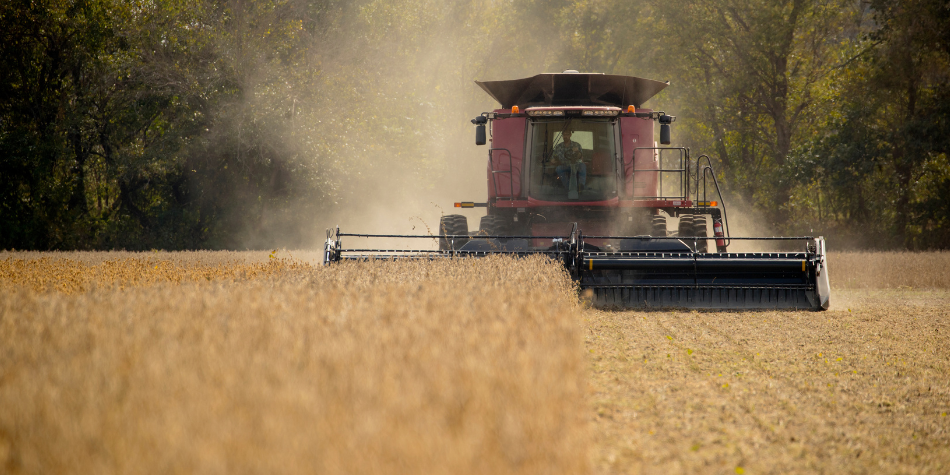
What if the next generation of automotive components, food packaging and construction materials began on Tennessee farmland?
Researchers at the University of Tennessee, Knoxville (UTK) are working to make that vision a reality at the UT Institute of Agriculture (UTIA) Center for Renewable Carbon (CRC), developing plant-based technologies that could create new markets for farmers, strengthen rural manufacturing and reduce reliance on petroleum-based products. Through partnerships with the UT Research Foundation (UTRF), those discoveries are moving beyond the laboratory and into the commercialization pipeline.
Renamed in 2010, the CRC brings together researchers from multiple disciplines to develop renewable chemicals, fuels and materials from agricultural and forestry feedstocks. Its work focuses on creating value from plants while keeping carbon in a circular bioeconomy.
The CRC is led by director Niki Labbé, a professor of biomass chemistry at the UTIA School of Natural Resources and recipient of the 2025 Charles E. Wharton Institute Professor Award.
Innovation at the Center for Renewable Carbon
Automotive
One of the CRC’s most prominent innovations is their work with Volkswagen Group of America to produce bio-based composite materials for automotive applications. Over the past six years, they’ve worked to replace pure plastic interior components with a bio-based composite.
The resulting materials can reduce plastic use while maintaining performance.
“We can create parts that are 60% natural fibers and 40% polypropylene,” said David Harper, Ph.D., a professor at the UTIA School of Natural Resources. The team is also adjusting other plastics, polymers and natural fibers to create parts that are stronger, stiffer and more lightweight than injection molded plastics and competing natural fiber composites used today.
A core goal of the CRC is to design biobased materials for full life-cycle performance, with end-of-life solutions engineered from the outset. The CRC conducts life-cycle assessments to quantify reductions in carbon emissions, resource use and other environmental impacts from manufacturing through end of life. To support this mission, Labbé and Harper developed an enzymatic recycling process that deconstructs composite materials and recovers both the plant-derived carbon fraction and petroleum-based components, enabling true material circularity rather than downcycling.
Packaging
Beyond automotive applications, the CRC is also developing plant-based technologies to make packaging more sustainable. One focus is bio-based coatings/additives designed to replace polyfluoroalkyl substances (PFAS), a class of chemicals commonly used in food packaging for grease and moisture resistance.
Genera, a Tennessee company based in Vonore, has partnered with the CRC for years, helping guide innovations from the laboratory into practice. A spin off from a UTRF subsidiary created in 2008 to advance the cellulosic biorefinery work of the UT Biofuels Initiative, Genera has since grown into a leader in biobased manufacturing, producing commercially compostable packaging, non-wood pulp and other products using grass fibers.
Construction and More
CRC researchers are also innovating lignin-based foams to serve as insulating materials and flame retardants. “We’ve demonstrated superior flame-retardant properties compared to Styrofoam or urethane-based foams that are currently used,” said Harper. Many conventional foams rely on petroleum-derived ingredients and can generate hazardous emissions during manufacturing.
Other applications the CRC is exploring include binders for asphalt and lignin-based carbon fibers. Asphalt binders are a minor but expensive component of asphalt. “If we can add lignin as a replacement for bitumen, which is coming from oil right now, it could be a very large market and add a lot of value to the lignin we’re producing too,” said Harper.
Harper’s group has also produced lignin-based carbons for battery anodes and lignin-based carbon quantum dots for gas separation, improved electrochemical performance for chemical cells, and, in cooperation with the UTIA College of Veterinary Medicine, new materials providing breakthroughs in regenerative medicine.
Moving Innovations to Market
Moving innovations from laboratory discovery to marketplace adoption is a team sport, and since 2010, CRC researchers have disclosed more than 30 invention disclosures and earned eight issued patents.
Through patent protection, licensing support, industry engagement and more, UTRF helps researchers navigate the commercialization process, protect IP, and connects innovators with the companies, investors and strategic partners capable of bringing them to market.
“UTRF’s expertise in technology transfer has allowed us to protect our intellectual property and effectively bring our research into the commercial world,” said Labbé. “They’ve not only helped with the technical aspects but also provided valuable guidance on developing strong business strategies that complement our research initiatives.”
Harper says, “I want to solve real world issues that impact people’s lives. Translating that is extremely important and UTRF plays a huge role in that translation.”
Bridging the Gap
As CRC technologies mature, researchers are looking beyond individual innovations to the broader challenge of building a regional bioeconomy capable of supporting farmers, manufacturers, and rural communities.
The Biobased Rural Innovation for Domestic Growth and Economic Security (BRIDGES) proposal, co-developed by the HudsonAlpha Institute for Biotechnology, UTK and Auburn University, is in the final stage of competition in the National Science Foundation’s (NSF) Regional Innovation Engines program.
The BRIDGES project could secure a $160 million award to build a circular bioeconomy, drive innovation, support farmers and strengthen rural communities across the Southeast over the next 10 years.
Labbé, one of the co-principal investigators for BRIDGES, said the innovation engine proposes to address key technical hurdles in matching the needs of industry and regional farmers.
“The goal is to create manufactured products and chemicals using locally grown grasses,” she said. These grasses, primarily miscanthus and switchgrass, are often grown on underused and marginal lands, so the proposed initiative will create new markets for farmers.
“UT and our BRIDGES partners are working with manufacturers to address workforce development and training needs,” Labbé added. “As our research advances, the creation of a circular bioeconomy will provide rural communities with access to high-paying jobs and support workers who are interested in expanding their skills.”