Semi-Analytical Method to Solve AC Power Flows
The Problem
Fast growing electricity markets and relatively slow upgrades on transmission infrastructure have pushed many power systems to occasionally operate close to power transfer limits and raised more concerns about potential voltage instability. Iterative numerical methods are commonly used to solve AC power flow problems, but they often diverge under abnormal or ill-conditioned situations, especially when the system is pushed close to its voltage stability limit.
The Solution
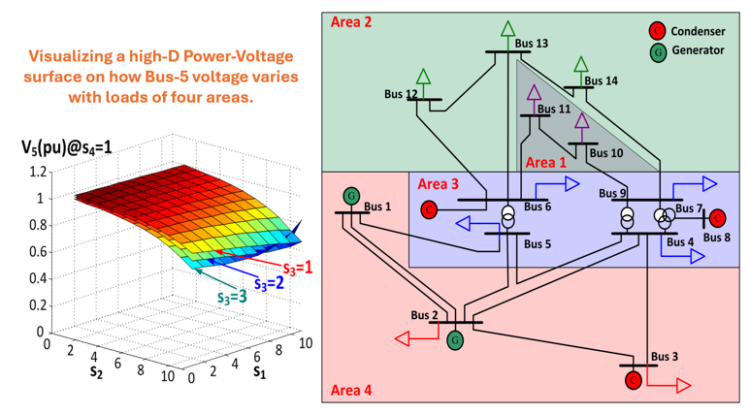
Researchers at the University of Tennessee have developed a non-iterative, semi-analytical method based on a multi-dimensional holomorphic embedding technique to approach the true power flow solution even when the system is close to its stability limit. This method allows stochastic effects and control designs to be embedded into power injections or consumptions of selected buses, enabling direct computation of bus voltage variations as multivariate power series with adaptive accuracy. Since the solution can be obtained offline and deployed in real time, it fits well into online applications such as voltage stability assessment and control.
Benefits
| Benefit |
|---|
| Obtains the explicit power flow solutions for any AC power system even when it is close to the stability limit |
| Works well with online applications, such as voltage stability assessment and control |
| Computational burden is not significantly impacted |
More Information
- Gregory Sechrist
- Technology Manager
- 865-974-1669 | gsechris@tennessee.edu
- UTRF Reference ID: 18116
- Patent Status: US 11,271,398
- Category: Energy
Innovators
Kai Sun
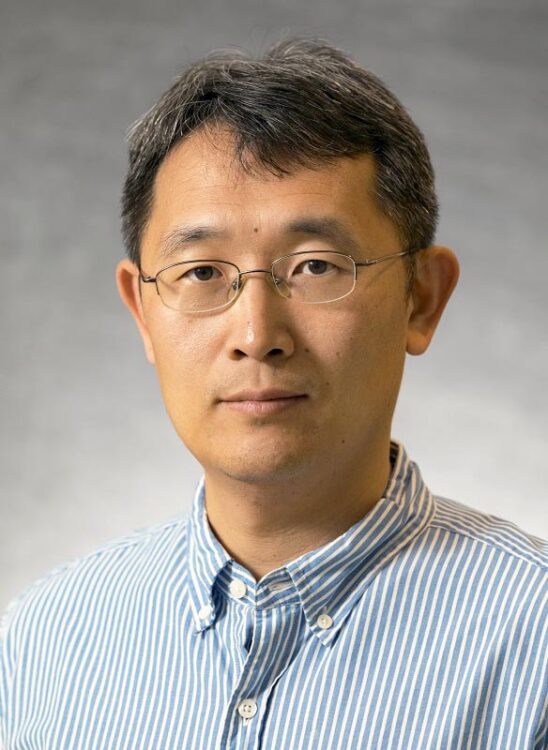
Professor, Department of Electrical Engineering and Computer Science, IEEE Fellow
Dr. Sun is a professor of electrical engineering and computer science and also a member of the Center for Ultra-Wide-Area-Resilient Electric Energy Transmission Networks (CURENT). His current research activities focus on faster-than-real-time power system simulations, understanding, preventing and mitigating cascading failures in power grids, wide-area measurements-based power system analysis a...
Dr. Sun is a professor of electrical engineering and computer science and also a member of the Center for Ultr...