Recycled and Commodity Polymers as Powder Bed Fusion Feedstock
The Problem
Powder bed fusion (PBF) additive manufacturing remains constrained by a narrow and expensive feedstock supply. Existing material’s limited performance ceiling makes it unsuitable for demanding aerospace, medical, and chemical processing applications, while conventional powder production methods prevent many high-performance polymers from being practically used in PBF. Additionally, no established pathway exists for incorporating post-consumer recycled plastics as viable feedstock, leaving degraded and un-sintered powder as waste rather than a recoverable resource.
The Solution
Researchers at the University of Tennessee, Knoxville have developed a novel powder fabrication process that produces highly uniform, spherical particles optimized for PBF applications across a broad range of polymer systems — including polypropylene/polycarbonate blends, recycled polyethylene, and other commodity and recycled polymers. The process is tunable, allowing researchers to directly influence final part characteristics through feedstock design, and enables the use of recycled materials as viable PBF inputs, simultaneously expanding the available feedstock landscape and reducing cost.
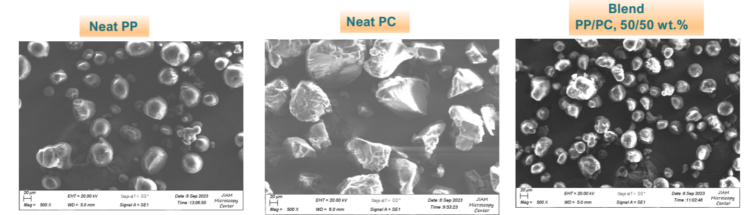
Comparison of particle size and characteristics across polypropylene, polycarbonate, and polypropylene/polycarbonate blends.
Benefits
| Benefit |
|---|
| Tunable particle size and morphology enable rational feedstock design to meet specific PBF process requirements |
| Produces spherical, flowable particles from polymer systems often incompatible with conventional powder production methods |
| Expands available PBF feedstock beyond PA 12 to include recycled and commodity polymers |
| Feedstock composition directly controls final part characteristics, enabling application-specific performance |
| Creates a viable pathway for post-consumer recycled plastics to enter the additive manufacturing supply chain |
More Information
- Derek Eitzmann
- Assistant Technology Manager
- 865-974-2687 | deitzman@tennessee.edu
- UTRF Reference ID: 26118
- Patent Status:
- Category: Chemistry & Materials, Engineering
Innovators
Mark Dadmun, Ph.D.

Professor, Department of Chemistry, University of Tennessee, Knoxville
Dr. Dadmun holds a B.S. in Chemical Engineering and a Ph.D. in Polymer Science and Engineering from the University of Massachusetts and completed a National Research Council Postdoctoral Fellowship at the National Institute of Standards and Technology. His research focuses on optimizing the properties of polymer mixtures through structural control of polymeric components, with demonstrated experti...
Dr. Dadmun holds a B.S. in Chemical Engineering and a Ph.D. in Polymer Science and Engineering from the Univer...
Saifuddin Ahmed

Graduate Researcher, Polymer Chemistry, Department of Chemistry, University of Tennessee, Knoxville
Ahmed is a graduate student in polymer chemistry whose research focuses on powder bed fusion-based additive manufacturing, with an emphasis on polymer blends as feedstock materials for 3D printing.
Ahmed is a graduate student in polymer chemistry whose research focuses on powder bed fusion-based additive ma...
Akan George, Ph.D.

Polymer Chemist and Research Scientist
Dr. George holds a Ph.D. in Polymer Chemistry and brings over five years of experience in academic and industrial R&D. His expertise spans polymer formulations, additive manufacturing, and advanced polymer characterization, with a strong record of collaborating with industry partners and leading research teams.
Dr. George holds a Ph.D. in Polymer Chemistry and brings over five years of experience in academic and industr...