Expanding Metal Compatibility in Ultrasonic Additive Manufacturing
The Problem
Conventional Ultrasonic Additive Manufacturing (UAM), a solid-state process that bonds metal layers using ultrasonic vibrations, cannot reliably bond certain metals, most notably titanium. Titanium's exceptional material properties limit its plastic deformation, which is the fundamental mechanism UAM relies on to create bonds. In practice, titanium pieces fracture, tear, or fail to bond, rendering titanium largely unusable in conventional UAM workflows despite its high value in the aerospace, defense, medical, and automotive industries.
The Solution
Researchers at the University of Tennessee have developed and patented (US12551970B2) a novel metallic interlayer method that enables the successful UAM of titanium and other metals previously incompatible with conventional UAM processes. The technology features the deposition of vanadium onto a titanium surface prior to UAM bonding, only requiring about half a second without melting, treatment, and no bulk chemical changes to the titanium itself. The method has been successfully demonstrated on both commercially pure titanium and Ti-6Al-4V — the industry-standard titanium alloy used across aerospace and medical applications. The same approach can also be extended to other difficult-to-process metals, making this a broadly applicable platform technology.
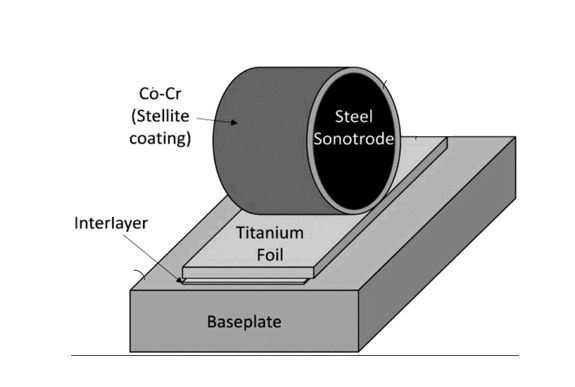
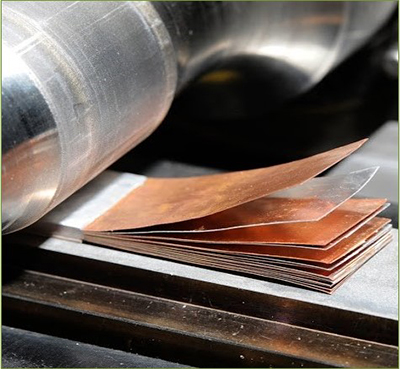
Apparatus performing Ultrasonic Additive Manufacturing of titanium metal
Benefits
| Benefit |
|---|
| Enables reliable bonding of commercially pure titanium and Ti-6Al-4V alloy, materials previously incompatible with UAM. |
| Only a minor amount of interlayer material is needed, keeping the process cost-effective. |
| The interlayer principle extends to other hard-to-bond metals, enabling a wide range of similar and dissimilar metal combinations. |
| Solid-state, low-temperature process, wherein bonding occurs without bulk melting, preserving material properties and reducing energy consumption. |
| Compatible with existing UAM equipment, thus requiring no redesign of existing manufacturing infrastructure. |
| Underlying principle extends to other hard-to-process metals (e.g., zirconium, magnesium) and enables new combinations of dissimilar metals. |
More Information
- Derek Eitzmann
- Assistant Technology Manager
- 865-974-2687 | deitzman@tennessee.edu
- UTRF Reference ID: 22115
- Patent Status: US 12,551,970
- Category: Chemistry & Materials, Engineering
Innovators
Michael Pagan, Ph.D.

Assistant Research Scientist, College of Engineering, University of Georgia
Dr. Pagan holds a B.S. in Materials Science and Engineering and a Ph.D. in Nuclear Engineering from the University of Tennessee. He completed a post-doctoral fellowship at Georgia Tech and is currently an assistant research scientist at the University of Georgia. His research focuses on the design, production, and performance of metals created through additive manufacturing, coupling experimental ...
Dr. Pagan holds a B.S. in Materials Science and Engineering and a Ph.D. in Nuclear Engineering from the Univer...
Steven Zinkle, Ph.D.

UTK-ORNL Governor’s Chair Professor for Nuclear Materials, University of Tennessee
Dr. Zinkle holds a Ph.D. in Nuclear Engineering from the University of Wisconsin-Madison, after which he joined Oak Ridge National Laboratory (ORNL) as a Wigner Fellow, eventually rising to Corporate Fellow and holding various research, group leadership, and division director roles before joining UT in 2013. His research spans materials behavior under extreme conditions, advanced and additive manu...
Dr. Zinkle holds a Ph.D. in Nuclear Engineering from the University of Wisconsin-Madison, after which he joine...
Sudarsanam Babu, Ph.D.

Clark Distinguished Chair Professor, University of Maryland, previous professor of mechanical engineering at UT Knoxville and UT/ORNL Governor's Chair
Dr. Babu holds a Ph.D. in Materials Science and Metallurgy from the University of Cambridge. His research focuses on designing and implementing materials and manufacturing innovations, including additive manufacturing, non-equilibrium phase transformations, and computational modeling. He applies advanced characterization tools such as neutron and synchrotron diffraction and electron microscopy to ...
Dr. Babu holds a Ph.D. in Materials Science and Metallurgy from the University of Cambridge. His research focu...