Current Limiting Control Scheme in a Solid-State Circuit Breaker (SSCB)
The Problem
Solid State Circuit Breakers (SSCB) can be utilized in DC distribution systems to provide current limiting to the circuit during fault and inrush scenarios. Three methods for embedding that current limiting function are (1) inductor and resistor adding, (2) operation as a chopper circuit, and (3) utilization of saturation mode for switches. However, a current limiting method with low weight-addon which is also capable of withstanding long duration of current limiting is necessary and is not provided by any of these three traditional methods.
The Solution
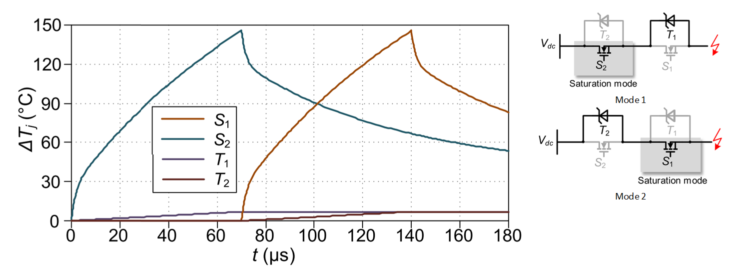
Researchers at the University of Tennessee have developed a novel control scheme designed to enlarge the current limiting capacity of SSCBs without adding additional hardware. The control scheme operates in two modes, one enabling a large portion of energy to dissipate via TVS diodes based on voltage distribution, and the second to control semiconductor switches in the negative line through gate-voltage adaptation. In tandem, all of the semiconductor switches and TVS diodes can be used to absorb energy during current-limiting operation.
Benefits
| Benefit |
|---|
| Current limiting time is improved by a factor of 3-4 compared to existing saturation-mode current limiting SSCB |
| No additional hardware needed and can be readily applied to existing series-connected SSCB switching cells without hardware modification |
| Simple and easily implementable control strategy |
| No high frequency switching and related EMI issues, and not sensitive to fault location |
More Information
- Gregory Sechrist
- Technology Manager
- 865-974-1669 | gsechris@tennessee.edu
- UTRF Reference ID: 22178
- Patent Status:
- Category: Energy
Innovators
Dr. Fei "Fred" Wang

Professor and Condra Chair of Excellence in Power Electronics, Min H. Kao Department of Electrical Engineering and Computer Science, UT Knoxville
Dr. Wang holds the Condra Chair of Excellence in Power Electronics and is a Professor in Electrical Engineering at The University of Tennessee. He is a founding member and the Technical Director of the NSF-DOE Engineering Research Center CURENT. He is conducting research on: design, modeling, control, and integration of advanced power electronics converters; motor drives; wide bandgap device chara...
Dr. Wang holds the Condra Chair of Excellence in Power Electronics and is a Professor in Electrical Engineerin...
Zhou Dong
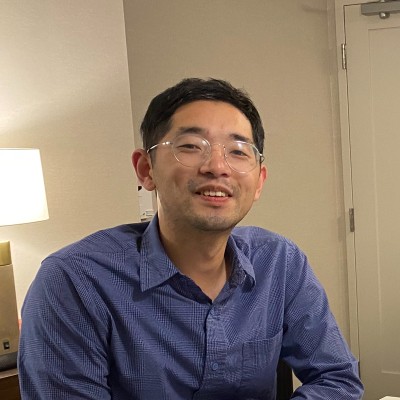
Principal Scientist - Power Electronics at ABB, former research assistant at the University of Tennessee, Knoxville
Dr. Zhou Dong received his Ph.D. in Electrical Engineering from the University of Tennessee Knoxville in 2022. His research interests include high frequency and high-power-density dc/dc converters, as well as Gallium Nitride based converter design.
Dr. Zhou Dong received his Ph.D. in Electrical Engineering from the University of Tennessee Knoxville in 2022....