Advanced Regenerative Agriculture Through Bio-Based Materials: Biodegradable Pots to Reduce Microplastics and Landfill Waste
The Problem
The horticulture and gardening industries rely heavily on single-use plastic containers, consuming over 500 million pots annually in the U.S. alone and generating roughly 350 million pounds of plastic waste. With recycling rates for these containers sitting at a dismal 3% to 5%, the vast majority end up in landfills taking anywhere from 20 to 1,000 years to decompose. As these plastics decompose, they introduce harmful microplastics and toxic chemicals into the environment. The agricultural market desperately needs a scalable, commercially viable alternative to traditional plastic planters that is cost effective without compromising structural integrity or plant health.
The Solution
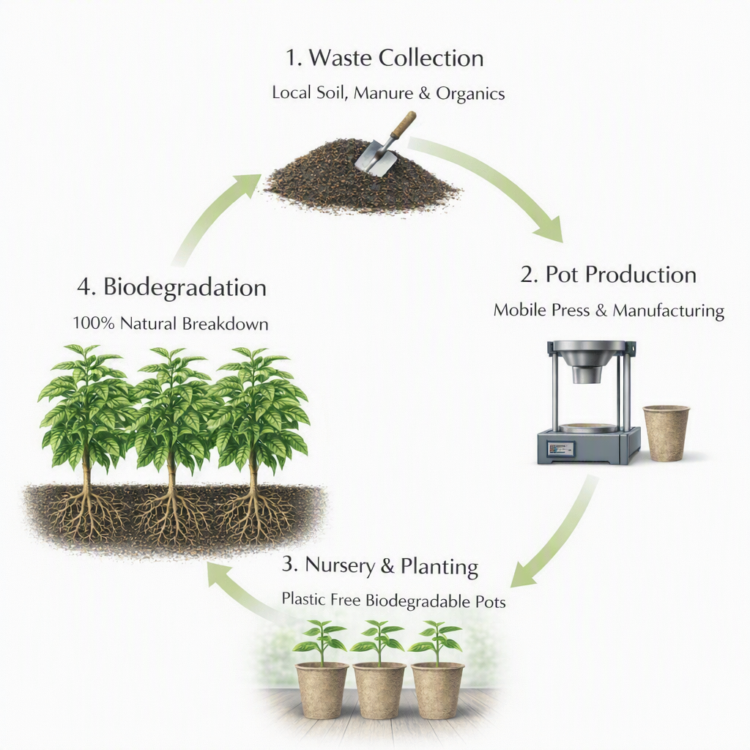
Researchers at the University of Tennessee have developed a novel manufacturing machine and optimized material compositions for producing 100% biodegradable, plastic-free plant pots from local natural waste (soil, manure, construction site soil). This technology is scalable, portable, mechanical or easily automated, and can tailor pot composition to meet various crop requirements. The innovation aligns with U.S. priorities to advance regenerative agriculture and strengthen American farm resilience, while supporting domestic bio-based manufacturing and more sustainable agricultural production.
Benefits
| Benefit |
|---|
| Environmentally Sustainable: Eliminates plastic waste and microplastic contamination by utilizing 100% biodegradable, earth-friendly materials. |
| Circular Economy for Cost-Effective Production: Repurposes abundant soil, manure, and other natural waste, significantly lowering raw material acquisition costs. |
| Customizable Nutrient Profiles: Pot compositions can be tailored with specific nitrogen, phosphorus, and potassium (N, P, K) levels to optimize growth for crops. |
More Information
- Gregory Sechrist
- Technology Manager
- 865-974-1669 | gsechris@tennessee.edu
- UTRF Reference ID: 26184
- Patent Status: Patent Pending
Innovators
Fuhar Dixit, Ph.D.

Assistant Professor, Department of Civil and Environmental Engineering, UT Knoxville
Fuhar Dixit joined the University of Tennessee Knoxville in 2026 where he focuses on the intersection of chemical engineering, environmental health, and sustainability. Bringing extensive experience from his Ph.D. at the University of British Columbia and postdoctoral research at UC Berkeley on environmental contamination, his interdisciplinary lab aims to develop practical, scalable solutions to ...
Fuhar Dixit joined the University of Tennessee Knoxville in 2026 where he focuses on the intersection of chemi...