Used globally in transportation, industrial processes and energy storage systems, hydrogen is emerging as a critical fossil fuel alternative to meet rising energy demands. With global demand for green hydrogen projected to increase more than twenty-fold to a $230 billion industry by 2035, improving efficiency and reducing production costs is becoming increasingly urgent.
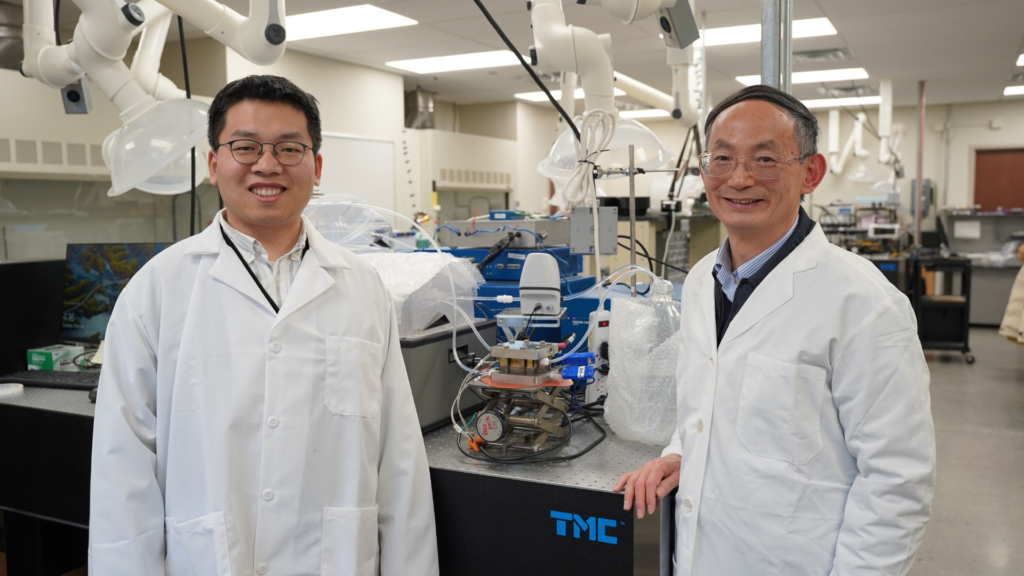
To meet growing demand, the University of Tennessee, Knoxville (UTK), Tickle College of Engineering’s Feng-Yuan Zhang, Ph.D., Professor of Mechanical and Aerospace Engineering, and Research Assistant Professor Weitian Wang are re-engineering the proton exchange membrane (PEM) electrolyzer to its electrode core.
The gap between laboratory performance and commercial utilization is where Zhang’s decades of research is focused, with more than 15 disclosures and three pending U.S. utility patents. “UTRF has been a tremendous partner; they’ve provided input on research and discussed disclosures and intellectual property protection strategies. They’ve also provided lots of guidance for commercialization.”
His cost-reduction approach is multi-faceted, focusing on enhancing performance and stability while lowering the use of expensive rare earth metals, reducing manufacturing time and processes.
“We are trying to improve performance and stability, and reduce costs at the same time,” Zhang said. “Those things usually work against each other.”
Rethinking the Catalyst Layer
A leading technology for producing hydrogen and energy storage is PEM electrolyzers, valued for their ability to operate at low temperatures and respond quickly to fluctuations in electric power supply. However, PEM electrolyzers suffer from high initial capital costs, which keep hydrogen production cost at a premium. To make the technology more economically viable, the U.S. Department of Energy set targets to reduce electrolyzer system costs by nearly 80% to $250 per kilowatt for low temperature electrolyzers and bring the cost of hydrogen production down to $2 per kilogram by 2026 and $1 per kilogram by 2031.
PEM electrolyzers rely on scarce, expensive precious metal catalysts, such as iridium and platinum, to drive the electrochemical reaction that splits water into hydrogen and oxygen. These catalysts lower the reaction’s energy requirements, improving efficiency and reducing the electricity needed to produce hydrogen. But the catalyst itself is costly, accounting for more than 50% of the electrode material cost.
Traditionally, applying the catalyst layer requires specialized expensive equipment, a time-consuming multi-step manufacturing process, and an ionomer binder that results in a thick, underutilized catalyst layer that wastes material. These costs significantly contribute to the capital cost of PEM electrolyzers, and ultimately, to the cost of hydrogen.
Zhang and Wang’s approach address these costs directly. Their method reduces electrode costs by more than 50% and cuts the manufacturing process from hours to minutes, without the need for expensive, specialized equipment.
The innovation enables the direct growth of an ionomer-free, ultra-low-loading catalyst layer onto the substrate at room temperature and ambient pressure, with minimal surface preparation. The resulting catalyst layer is 100 times thinner and achieves 50 times greater activation, reducing total catalyst material requirements by 90% without sacrificing performance or stability.
“If you can use much less precious metal catalyst without losing efficiency or stability, that’s a game changer,” Weitian said. “It directly impacts cost, scalability and supply chain risk.”
All About the Flow
Reducing material and production cost is not the only innovation stemming from Zhang’s lab. To improve PEM electrolyzer performance, Zhang also re-engineered the liquid/gas diffusion layer (LGDL). This new LGDL, the flow-enhanced LGDL (FELGDL), utilizes microchannels etched into thin titanium foil for maximum mass transport, ensuring all active areas are exposed to reactions and not blocked by land areas. This innovation increases performance by over 5% while reducing LGDL thickness by 250%, ultimately increasing output compared to similarly sized PEM stacks.
Enabling Scalable Hydrogen Production
Beyond cost reduction and improved performance, the team’s electrode design also addresses one of the most persistent challenges in hydrogen systems: durability under dynamic operating conditions.
Most electrolyzers are tested under steady laboratory conditions, but real-world systems rarely operate that way. Zhang’s group is demonstrating that the low catalyst loading and FELGDL design can handle the stability requirements under dynamic operating conditions.
“Real operation is not steady,” Zhang said. “You have changing current, changing temperature, changing conditions. If you don’t design for that, the system won’t last.”
Demonstrations of the scalability of these innovations are already underway, with the team fabricating larger-area electrodes using ultralow catalyst loadings. The next step is to manufacture electrodes exceeding 100 cm² in size and evaluate their performance within a multi-cell electrolyzer stack, with the goal of enabling large-scale hydrogen production and energy storage applications.
Moving from Lab to Market
Zhang and Wang’s research is conducted through UTK’s Electrochemical Energy Storage and Conversion Laboratory (EESCL) and the Nanodynamics and High-Efficiency Lab for Propulsion and Energy (NanoHELP), with a focus on translating laboratory innovation into deployable technology.
“We want this research to matter outside the lab – supporting communities, advancing sustainable energy technologies, and accelerating the transition to a resilient future,” Zhang said. “That is always the goal.”
For more than 10 years UTRF has worked with the researchers to commercialize their innovation and recently provided individual coaching through UTRF’s Executive in Resident program and aid with customer discover programs such as NSF I-corps and preparing for UTK’s Chancellor’s Innovation Fund.
Scaling up hydrogen production will require massive growth in electrolyzer capacity, along with secure supply chains for catalysts, membranes and other critical components. By reducing precious metal use, simplifying manufacturing and extending system lifetimes, Zhang and Wang’s work directly addresses some of the biggest barriers to PEM electrolyzer deployment at scale.
Together, their research reflects UTRF’s mission to move innovation from the lab to the marketplace – delivering solutions with the potential to benefit industry, communities and society.