



Skip to Main Content

Frequently Used Tools:


UT Research Foundation

The University of Tennessee Research Foundation (UTRF) helps inventors at The University of Tennessee (UT) turn their ideas and discoveries into products and services that benefit society. Use the following links to see more about our:


Services

UTRF provides several services to help transform UT inventions into products and services for the market. These include:

  • Evaluation of inventions, including assessment of:
    • Novelty
    • The ability to protect the ideas
    • The commercial potential of the inventions
  • Funding and managing the patent process
  • Marketing the invention to potential licensees
  • Negotiating license agreements
  • Managing licensee and government compliance issues
  • Registering copyrights or trademarks
  • Materials Transfer Agreements (MTAs)
  • Consulting on intellectual property (IP) provisions in research agreements
  • Collecting and distributing royalties
  • Supporting start-up companies based on UT technology
  • Confidentiality Agreements (CDAs)
  • Presenting educational seminars on intellectual property and start-up issues

Mission

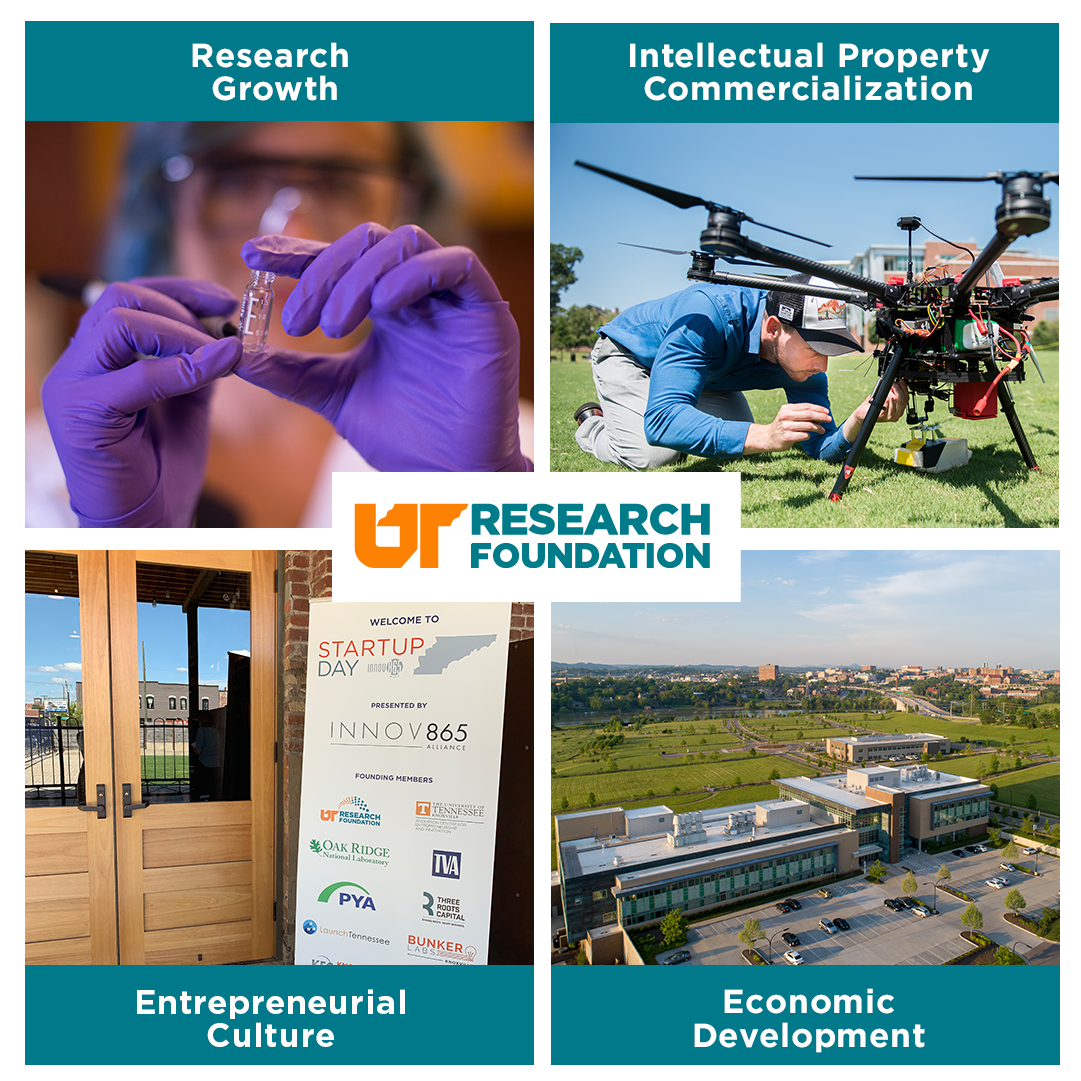
UTRF has a four-pronged mission:

1. Protect, manage and commercialize UT inventions (intellectual property, or “IP”)

  • Establish a culture where intellectual property disclosures are a routine, expected and rewarded product of research
  • Manage intellectual property in compliance with the Bayh-Dole legislation and other applicable laws and policies
  • Provide intellectual property counsel to UT employees
  • Evaluate and manage intellectual property to balance legal costs of protection with commercial potential
  • Aggressively market intellectual property to create a favored position for University research, start new businesses, and generate a solid income stream

2. Grow the UT research enterprise

  • Support and facilitate faculty-generated research initiatives
  • Market University research capabilities to industries and agencies
  • Assist in formation and coordination of research teams to compete for large, multidisciplinary, perhaps multi-institutional projects and centers
  • Facilitate and coordinate inter-campus initiatives and projects
  • Process and administer grants and contracts with terms and conditions that may not be easily accommodated by University
  • Foster strategic partnerships and alliances for the benefit of University’s research enterprise
  • Facilitate expanded collaborations with the Oak Ridge National Laboratory

3. Develop and support an entrepreneurial culture

  • Support innovative entrepreneurial education programs aimed at starting new businesses based upon University intellectual property
  • Provide advisory services to support entrepreneurial ventures
  • Support new start-up businesses in on-campus technology incubators
  • Create a venture fund to provide very early stage capital for new technology start-up businesses founded with University intellectual property

4. Contribute to state and regional economic development

  • Partner with the State and the various economic development organizations to create jobs, generate new revenue streams, and make new technologies commercially available to the citizenry

History

Originally formed as The University of Tennessee Research Corporation (UTRC), the University of Tennessee Research Foundation (UTRF) has a long history of working with inventors to bring technology to the marketplace.

UTRC was chartered on January 19, 1935, to promote research and encourage the market utilization of research results. In the early years, most of the activities of UTRC involved agricultural inventions.

The 1950s were UTRC's era of stability, during which time several new products were licensed. During the 1960’s, the board, however, saw that market, business and technology trends would have an impact on the success UTRC. As a result, UTRC entered into a lengthy study of its purpose and activities.

The 1970s were transitional years for UTRC. Many of the products that had been successful in years past were no longer marketable. The types of disclosures received shifted from agricultural and mechanical inventions to discoveries in biology, chemistry or pharmaceutical compounds. UTRC expanded the scope of its activities and hired its first executive director, Professor William A. Goodwin, in 1979. He was succeeded in 1980 by Professor W. Ken Stair, who directed the corporation until 1983. In 1983, Dr. Kenneth W. Heathington was appointed executive director by the UTRC Board and became president, and was succeeded by Ann J. Roberson in 1992.

In 1984, the Board of Directors was expanded to include representatives of every campus, university-wide administration, business and government. UTRC actively encouraged faculty and staff members to disclose inventions and marketed them to commercial entities. In addition, new methods for commercialization were introduced, such as joint ventures with equity partnerships between UTRC, faculty members, and venture capital firms.

UTRC was renamed and reorganized in April of 2003 to the University of Tennessee Research Foundation (UTRF). Roles were redefined and the scope was expanded to include a new emphasis on entrepreneurship and economic development for technology transfer activities. A new set of bylaws and Board of Directors were established, and Dr. Fred Tompkins became president and CEO.

The importance of emerging technologies as a viable benefit of university research and development is increasingly recognized, and UTRF will continue adapting its activities and focus to provide the best service and return to the university and the region.


UTRF Annual Report


Click here to see a brochure that provides an overview of our organization and services.