Smart Pixel Circuit
The Problem
Image binarization plays a crucial role in numerous AI applications, especially in computer vision applications and document analysis in image segmentation, object recognition and edge detection. Further noisy environments and space constrained applications pose significant challenges with existing hardware. As such there is a need for a compact, high-speed, low-power, and low-area sensor circuit to perform image binarization.
The Solution
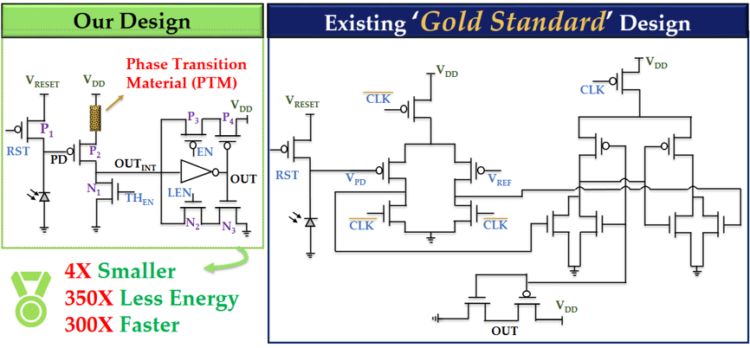
Researchers at the University of Tennessee have developed unique image binarization circuitry and topology (the BHPS Circuit) which resides within individual pixels themselves. This pixel-level or in-pixel binarization scheme offers low area (0.1764 μm), low pitch (0.65 μm), low energy (0.152 fJ)and high speed due to its compactness and simplicity, which is achieved through the use of phase transition materials within the topology. Further this technology utilizes a variable thresholding technique, allowing the sensor to adeptly discerns scene features across diverse lighting conditions. Applications for this technology include aerospace and defense, automotive, home security, AI sensing applications, and more.
Benefits
| Benefit |
|---|
| 300X faster - Bypasses diode-size bottleneck problem |
| 350X Less Energy -In pixel processing results in high speed and low power consumption – switching energy of 0.152fJ |
| Variable thresholding feature works in various light conditions and on pixel processing can reduce cloud data storage for improved privacy and security. |
| Saves the use of roughly 20 transistors in the binarization circuitry. |
More Information
- Gregory Sechrist
- Technology Manager
- 865-974-1669 | gsechris@tennessee.edu
- UTRF Reference ID: 24159
- Patent Status: Patent Pending
- Category: Engineering
Innovators
Ahmedullah Aziz

Associate Professor, Department of Electrical Engineering and Computer Science at the University of Tennessee, Knoxville | Forrest Eisenhart Family Faculty Awardee
Dr. Ahmedullah Aziz explores device-circuit-system co-design techniques with an emphasis on emerging technologies. He has received multiple awards and accolades for his research and has published over 80 scientific articles in this space.
Dr. Ahmedullah Aziz explores device-circuit-system co-design techniques with an emphasis on emerging technolog...
Md Rahatul Islam Udoy

Graduate Student, Department of Electrical Engineering and Computer Science at the University of Tennessee, Knoxville
Mr. Udoy is a graduate student working in the Nanoelectric Devices and Integrated Circuits Lab (NorDIC Lab) at UT Knoxville. He has received the prestigious Top 100 Graduate Fellowship from the graduate school and has co-authored several papers on cryogenic synapses, digital pixel sensors and automatic pre-processing systems.
Mr. Udoy is a graduate student working in the Nanoelectric Devices and Integrated Circuits Lab (NorDIC Lab) at...