RadioGami: Batteryless, Long-Range Wireless Paper Sensors Using Tunnel Diodes
The Problem
Traditional electronics substrates, such as polyimide, PDMS, silicon, and metal foils, are costly, rigid, and poorly suited for embedding sensors into everyday objects at scale. Paper-based platforms are a low-cost alternative but have traditionally been wired or battery-powered, offsetting the initial cost with operational costs and limited scalability. Further, Tunnel Diode Oscillator (TDO) systems offer a promising path to long-range wireless sensing, but have been traditionally built on rigid printed circuit boards, leaving a need for integration of TDO circuits onto low-cost flexible substrates.
The Solution
Researchers at the University of Tennessee, Knoxville have developed RadioGami, a battery-free, low-cost, easy-to-manufacture, long-range wireless paper sensor platform that integrates ultra-low-power TDO circuits onto paper substrates, generating RF signals locally and harvesting energy from ambient light rather than relying on batteries or wired power. This platform supports various physical embodiments with defined assembly methods, enabling flexible deployment across a broad range of sensing applications.
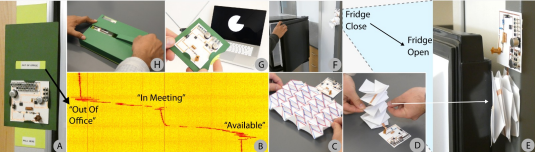
Various configurations and functions using RadioGami technology.
Benefits
| Benefit |
|---|
| Battery-free and ambient light powered operation, using just 35 µW |
| Has a long range RF signal, demostrating wireless sensing range up to 45.73 meters |
| Able to be fabricated at a low-cost at about $20 using cheap materials and off-the-shelf electronics |
| Able to be used in multiple environments, spanning workspace monitoring, environmental and object sensing, package integrity and tamper detection, origami-inspired interactive surfaces, and IoT integration |
More Information
- Gregory Sechrist
- Technology Manager
- 865-974-1669 | gsechris@tennessee.edu
- UTRF Reference ID: 26018
- Patent Status:
- Category: Engineering
Innovators
Sai Swaminathan

Assistant Professor, Min H. Kao Department of Electrical Engineering and Computer Science, UT Knoxville
Dr. Swaminathan is an assistant professor in the Min H. Kao Department of Electrical Engineering and Computer Science (EECS) at the University of Tennessee (UT). He received his Ph.D. from the Human-Computer Interaction Institute in the School of Computer Science of Carnegie Mellon University. He has published award-winning work at top-tier HCI venues, including ACM CHI, IMWUT (UbiComp), UIST, and...
Dr. Swaminathan is an assistant professor in the Min H. Kao Department of Electrical Engineering and Computer ...
Imran Fahad

Ph.D. student, Min H. Kao Department of Electrical Engineering and Computer Science, UT Knoxville Tickle College of Engineering
Imran Fahad began his career at BUET in Bangladesh and is now a doctoral researcher in the EPIC Lab. His research spans low-power electronics, smart materials, energy harvesting, RF communication, human-computer interaction, embedded machine learning, computer vision and wireless sensing.
Imran Fahad began his career at BUET in Bangladesh and is now a doctoral researcher in the EPIC Lab. His resea...
Dan Scott

Ph.D. student, Min H. Kao Department of Electrical Engineering and Computer Science, UT Knoxville Tickle College of Engineering
Dan Scott is a doctoral researcher in the EPIC Lab, building on a background in data analytics and enterprise architecture. His work spans machine learning, human-computer interaction, human-robot interaction, and battery-free sensing, including ACM-recognized research at UbiComp/ISWC 2025.
Dan Scott is a doctoral researcher in the EPIC Lab, building on a background in data analytics and enterprise ...
Azizul Zahid

Ph.D. student, Min H. Kao Department of Electrical Engineering and Computer Science, UT Knoxville Tickle College of Engineering
Azizul Zahid is a doctoral researcher in the EPIC Lab working across on-device LLM inference for task-specific Human-AI interaction, including intelligent guidance systems and LLM deployment on resource-constrained devices with hands-on experience building reinforcement-learning robotic systems.
Azizul Zahid is a doctoral researcher in the EPIC Lab working across on-device LLM inference for task-specific...