Power Flow Solution Based on Deep Convolutional Neural Network
The Problem
Power system flow equations have traditionally been solved by model-based analytical methods. Increasing resources being introduced into power grid systems has presented challenges to conducting accurate system modeling. This strain requires significantly more flow calculations. Traditional model-based power system flow calculation methods may experience significant computational burdens and fail to meet real-time and multi-scenario analysis requirements. These analytic methods are likely to fail in instances of resource integration on a large scale or dimension.
The Solution
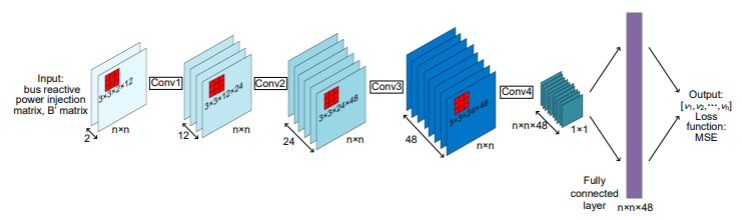
Researchers at the University of Tennessee have developed a novel data-driven method for power flow calculation based on deep convolutional neural network (CNN) as an efficient alternative to the traditional model-based method. No algebraic functions are required to model a given power system. Instead, the CNN learns the topology and mapping between system control variables and system state variables via feature extraction from existing power flow results. Once the CNN is equipped with the knowledge of power flow calculation, it can be directly adapted to new operation conditions to obtain power flow results without intensive computation.
Benefits
| Benefit |
|---|
| Improved efficiency and accuracy in complex, multi-dimensional power system calculations |
| Outputs power flow results instantaneously |
| Reduces computation costs |
| Can be deployed in online applications |
More Information
- Gregory Sechrist
- Technology Manager
- 865-974-1669 | gsechris@tennessee.edu
- UTRF Reference ID: 19058
- Patent Status: US 11,544,522 B2
Innovators
Dr. Fangxing (Fran) Li

James W. McConnell Professor in the Department of Electrical Engineering and Computer Science (EECS) at The University of Tennessee Knoxville. He is also an adjunct researcher at the Oak Ridge National Laboratory (ORNL).
Dr. Fangxing (Fran) Li received his PhD from Virginia Tech University in 2001. His research interests include renewable energy integration, distributed energy resources, and power system computational methods. He is an adjunct researcher at Oak Ridge National Laboratory and the campus director of Center for Ultra-Wide-Area Resilient Electric Energy Transmission Networks (CURENT).
Dr. Fangxing (Fran) Li received his PhD from Virginia Tech University in 2001. His research interests include ...