Regime for Thermal Runaway Mitigation Via Specific Discharge Rates
The Problem
Lithium-ion batteries in electric vehicles and energy storage systems are susceptible to thermal runaway, where exothermic reactions can lead to fire, explosion, and cascading cell propagation. The research gap of the competing effects of electrochemical heat generation and reduced state of charge during discharge create fundamental ambiguity, leaving a critical gap in validated mitigation strategies.
The Solution
Researchers at the University of Tennessee have developed an active discharge based programmable control strategy for thermal runaway mitigation allowing for a reliable thermal runaway mitigation strategy for lithium-ion batteries, including extreme situations in which thermal runaway exothermicity has already begun. This control strategy is capable of isolating thermal runaway and non-thermal runaway discharge rates and can be easily implemented in current battery management systems. Using an Accelerating Rate Calorimeter under adiabatic, Dr. Zhao and his team have validated a discharge window within which state-of-charge reduction consistently dominates over electrochemical heat generation, preventing thermal runaway across a range of discharge currents, onset temperatures, and external heating rates.
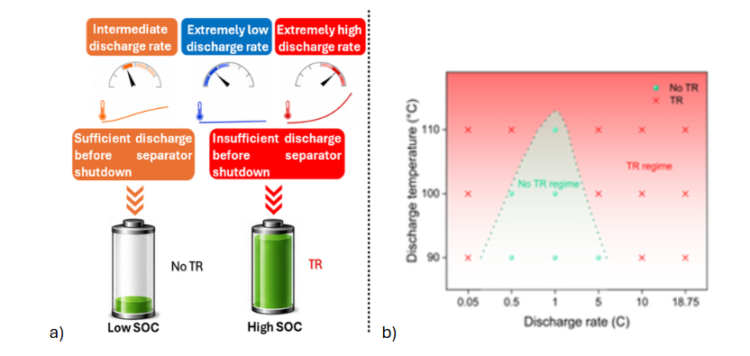
a) Thermal mitigation strategies involving battery discharge show that a discharge window exists wherein thermal runaway is suppressed at intermediate discharge rates.
b) The programmable control strategy represented by the regime diagram and methodology provide useful guidance for advanced battery management systems and thermal runaway mitigation to ensure safety.
Benefits
| Benefit |
|---|
| Discharge depth directly controls thermal runaway severity, yielding a validated parametric boundary for scalable mitigation. |
| Programmable Control Strategy - a wide range of tested discharge rates consolidate into a single regime that captures the conditions governing thermal runaway. |
| Actively suppresses thermal runaway even after the thermal runaway cascade has begun by ensuring state-of-charge reduction outpaces heat generation, even at aggressive discharge rates. |
| Requires zero hardware integration since it deploys into existing Battery Management Systems (BMS) as a programmable software upgrade, requiring no physical redesign. |
| Presents a universal safety regime by consolidating complex discharge variables into a single, reliable control regime that captures the conditions governing thermal runaway. |
| Technology presents broad market applications since it is universally applicable and highly scalable for both electric vehicle (EV) platforms and energy storage systems (ESS). |
More Information
- Gregory Sechrist
- Technology Manager
- 865-974-1669 | gsechris@tennessee.edu
- UTRF Reference ID: 26124
- Patent Status:
- Category: Energy

Innovators
Peng Zhao, Ph.D.

Associate Professor in Mechanical, Aerospace and Biomedical Engineering at UT Space Institute
Dr. Peng Zhao’s research interests span fundamental and application-oriented problems in combustion, propulsion, energy conversion, and fire safety, with current activities including Li-ion battery safety and thermal management, reacting flow CFD, low-carbon fuels, and advanced engine combustion strategies. He has published approximately 50 peer-reviewed articles in leading combustion and energy j...
Dr. Peng Zhao’s research interests span fundamental and application-oriented problems in combustion, propulsio...