Membrane-Free, High-Power Aluminum-Air Battery
The Problem
Aluminum-air batteries offer low cost, high specific energy, and simple mechanical recharging, yet consistently underperform in real-world systems. The shortcomings are structural: complex multi-gasket sealing creates numerous failure points; anion-exchange membranes must remain continuously KOH-soaked, leading to swelling, delamination, and mechanical failure after only 5–6 cycles; and passive air-breathing cathodes suffer severe oxygen-transport limitations that cap power well below the anode's potential. Incremental fixes leave these root constraints intact, ultimately undermining performance, durability, and manufacturability.
The Solution
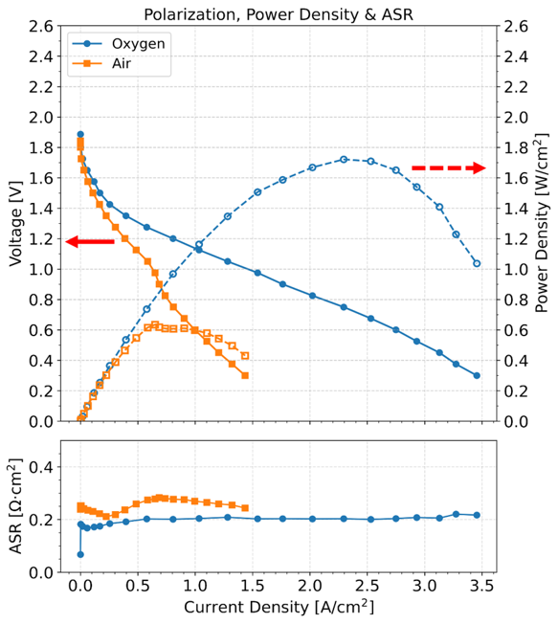
Researchers at the University of Tennessee have developed a membrane-free, 3D-printed aluminum-air battery delivering at least three times more peak power than any previously published design. A single-frame architecture with active electrolyte flow and forced oxygen delivery eliminates membranes, gaskets, and complex seals. Spent aluminum plates swap in seconds for instant recharging. Peak power densities reach 1.7 W/cm² at 0.75 V, making the technology well suited for stationary storage, emergency backup, military, and off-grid applications.
Visual description:
Comparison of polarization behavior, power density, and area-specific resistance (ASR) of the aluminum-air battery operated with pure oxygen (105 sccm) and air (500 sccm) at the cathode. All experiments were performed using a 5N aluminum anode, 6 M KOH electrolyte containing 0.1 M Na2SnO3, cell and electrolyte temperatures of 70 °C, and an electrolyte flow rate of 50 mL/min. Solid lines denote the polarization curves, while dashed lines denote the corresponding power density curves.
Benefits
| Benefit |
|---|
| Delivers 1.72 W/cm2 peak power density, three times higher than any previously published aluminum-air battery. |
| Single frame eliminates membranes, gaskets, and seals, significantly reducing material, assembly, and maintenance costs. |
| Spent aluminum cases can be swapped in seconds with no special tools, presenting a rich optimization space. |
| Membrane-free design eliminates the primary failure point and enables reliable operation from -40°C to 80°C+, including stopping standby corrosion. |
| Al-air battery exhibits fundamentally different performance scaling than Li-ion batteries. |
| Intrinsically high safety as the design mitigates risks of flammability and explosion. |
More Information
- Gregory Sechrist
- Technology Manager
- 865-974-1669 | gsechris@tennessee.edu
- UTRF Reference ID: 26015
- Patent Status: Patent Pending
- Category: Energy, Engineering

Innovators
Preetam Sharma Ph.D.

Research Assistant Professor, Department of Mechanical and Aerospace Engineering
Dr. Sharma’s work focuses on advancing sustainable energy technologies, specializing in designing, developing, and optimizing next-generation electrochemical systems, including hydrogen fuel cells, metal-air, lithium-ion, redox-flow batteries, and water electrolyzers.
Dr. Sharma’s work focuses on advancing sustainable energy technologies, specializing in designing, developing,...
Matthew Mench, Ph.D.

Dean, Tickle College of Engineering, Condra Chair, and Chancellor’s Professor
Dr. Mench is an internationally recognized authority in electrochemical power conversion and storage, his expertise encompasses polymer electrolyte fuel cells, flow battery systems, biological energy systems, multi-phase transport and visualization, computational simulations of electrochemical and power conversion and energy systems, and electrochemical methods of hazardous waste conversion.
Dr. Mench is an internationally recognized authority in electrochemical power conversion and storage, his expe...
Thomas Zawodzinski, Jr., Ph.D.

Professor and Governor’s Chair in Electrical Energy Conversion and Storage for UT-ORNL
Dr. Zawodzinski and his research group is globally recognized for advancing the fundamental science and application of fuel cells, redox flow batteries, high-energy density batteries, and metal-air batteries, with a particular emphasis on the development and understanding of catalyst materials, electrolytes and composite electrodes, water management, and application of NMR to chemical engineering ...
Dr. Zawodzinski and his research group is globally recognized for advancing the fundamental science and applic...
Doug Aaron, Ph.D.

Assistant Department Head, Undergraduate Programs, Research Assistant Professor, Department of Mechanical and Aerospace Engineering
Dr. Aaron’s research specializes in redox flow battery diagnostics, high energy density batteries, low-temperature fuel cells and electrolyzers, and other large electrochemical energy storage technologies.
Dr. Aaron’s research specializes in redox flow battery diagnostics, high energy density batteries, low-tempera...
Gabriel Goenaga-Jimenez, Ph.D.

Senior Research Associate, Zawodzinski Research Group
Dr. Goenaga-Jimenez’s research specializes in low-temperature fuel cells and electrolyzers, redox flow batteries, non-precious metal catalysts, metal-air batteries, and electrophoretic NMR.
Dr. Goenaga-Jimenez’s research specializes in low-temperature fuel cells and electrolyzers, redox flow batter...
Ali Mizrak, Ph.D.

Post-Doctoral Research Associate, Department of Mechanical and Aerospace Engineering
Dr. Mizrak’s research specializes in electrochemistry and the advancement of energy storage and conversion technologies including metal air batteries, fuel cells, and hydrogen generation.
Dr. Mizrak’s research specializes in electrochemistry and the advancement of energy storage and conversion tec...