Click Coupling Biomolecules to Substrates with Cyclooctyne N-Heterocyclic Carbenes
The Problem
Biomolecules are frequently appended to metal nanoparticles or surfaces for drug delivery or biosensing. Many approaches have been developed for these applications but generally a linker molecule is required for maximum long-term stability. Conventionally, linkers featuring thiol groups form self-assembled monolayers on substrates but these interactions are not stable long-term and dissociate over time. Biomolecules such as enzymes or aptamers can be attached pre or post-substrate binding and the chemistry often requires catalysts or harsh reaction conditions.
The Solution
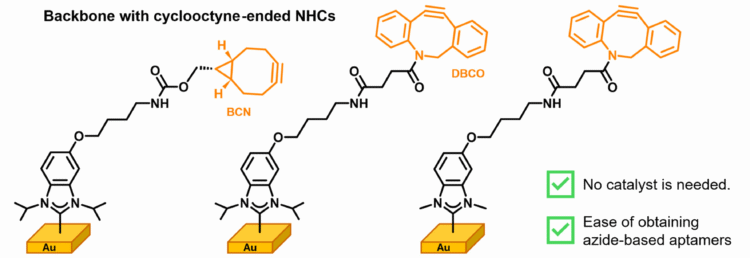
Researchers at the University of Tennessee and the University of Notre Dame have developed novel linkers for a wide variety of applications. The key linker feature is the usage of cyclooctyne moieties for attaching a wide variety of functional components equipped with an azide for copper-free click chemistry. This innovation enables a wider suite of potential applications due to the larger availability of azide functionalized biomolecules. The linkers also feature an N-heterocyclic carbene that provides much stronger bonding to metal surfaces compared to thiols. The carbenes can couple to a large variety of substrates in large or nanoparticle formats. These can be purposed for electrochemistry, delivery, or spectroscopic applications based on the substrate format and the linked functional component.
Additional Information:
Benefits
| Benefit |
|---|
| Biomolecules functionalized with azides are widely available and inexpensive |
| Strong substrate binding |
| Applicable to large substrates, microelectrodes, or nanoparticles |
More Information
- Derek Eitzmann
- Assistant Technology Manager
- 865-974-2687 | deitzman@tennessee.edu
- UTRF Reference ID: 24162-03
- Patent Status: Pending
Innovators
David Jenkins

Professor of Chemistry
The Jenkins group focuses on inorganic and organic synthesis to develop chemical systems ranging from homogenous catalysis, to porous frameworks, to surface modifications. We concentrate on three distinct areas of research, all of which are centered around the use of five-membered N-heterocycles (azoles) as ligands for transition metals. The first area is focused on developing macrocyclic tetra ...
The Jenkins Group specializes in inorganic and organic synthesis, utilizing five-membered N-heterocycles (**azoles**) as ligands for transition metals. Their research spans three key areas: developing **NHC-based catalysts** for oxidative group transfers, engineering **metal-organic nanotubes (MONTs)**, and modifying **nanoparticle surfaces** for medical and electronic applications. These materials are characterized using advanced techniques such as **NMR**, mass spectrometry, and **X-ray diffraction**.