• Skip to main content
  • Skip to footer

University of Tennessee Research Foundation

Technology Transfer & Licensing

  • About
    • Our Mission
    • Foundation Details
    • Student Opportunities
    • Staff
    • Subsidiaries
  • For Innovators
    • Accelerate Fund
    • Entrepreneurial Fellows Program
    • Technology Maturation Award
    • Business Incubator
    • IDEA Tutorial & Manuals
    • Technology Transfer Process
    • Resources
  • For Industry
    • Available Technologies
    • Express Licensing
  • Media
    • News
    • Newsletters
    • Annual Reports
  • Contact
  • UT Ventures

Applying auxetics to stent retriever mechanical thrombectomy

The Problem

Stroke is one of the leading causes of long-term disability worldwide. During an untreated ischemic stroke, an estimated 32,000 neurons are lost per second, making fast restoration of blood flow key to achieving good neurologic outcome. Through a stent retriever mechanical thrombectomy, a blood clot is trapped within the struts of a stent and the whole system is retracted to remove the clot and restore blood flow. Unfortunately, current commercially available devices often underperform by stretching or collapsing during the retrieval process. Underperformance influences the success of the procedure and can require multiple passes of the device to fully remove the blood clot, increasing the procedure time and risk of complications for the patient.

The Solution

To counteract device collapse during thrombectomy. Researchers at the University of Tennessee (UT) are developing an auxetic stent retriever design that expands under tension. Auxetics are metamaterials with a negative Poisson’s ratio (NPR) that expand when stretched. The unique performance of auxetic structures has already been applied to various biomedical devices, including permanent stents. UT researchers are now examining the benefits of an auxetic stent retriever for mechanical thrombectomy to improve clot integration and overall removal rates.
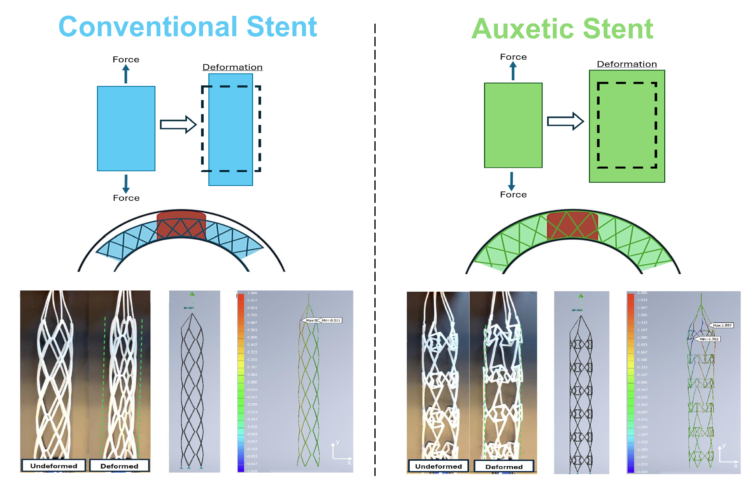
Figure 1. Comparison of conventional and auxetic stent retriever designs. (Top) Schematic describing the differences between positive (blue) and negative (green) Poisson’s ratio material. (Middle) Schematic depicting the behaviors of a conventional stent retriever with positive Poisson’s ratio (blue) and an auxetic stent retriever with a negative Poisson’s ratio (green) deployed within an artery and their degree of clot integration. (Bottom) Example 3D printed prototypes and computational simulations comparing conventional and auxetic stent retriever designs under tension.

Benefits

Benefit
Negative Poisson’s ration (NPR) prevents stent collapse during retrieval.
A successful auxetic stent retriever would improve stent-clot integration, decrease procedure times by increasing first-pass success, and improve patient outcomes.

More Information

  • Rachel Valentine
  • Assistant Technology Manager
  • 865-974-4492 | rvalen18@tennessee.edu
  • UTRF Reference ID: 26132
  • Patent Status: Patent Pending
blood, red blood cells, health, biology, bleeding, plasma, hemoglobin, ai generated

Innovators

Bryan Good

Assistant Professor, Department of Biomedical Engineering, UT Knoxville

Dr. Bryan Good earned his Ph.D. in Bioengineering from Penn State University in 2017 and spent two years as an American Heart Association Postdoctoral Fellow. He now runs the Cardiovascular Biomechanics lab at UT Knoxville. The mission of his research group is to improve clinical therapies and medical devices for cardiovascular and neurological diseases using expertise in experimental and computat...

Dr. Bryan Good earned his Ph.D. in Bioengineering from Penn State University in 2017 and spent two years as an...

Read more about Bryan Good
  • Rachel Valentine
  • Assistant Technology Manager
  • 865-974-4492 | rvalen18@tennessee.edu

Footer

  • LinkedIn
  • Twitter
  • YouTube

Knoxville Office

400 W. Summit Hill Drive
UT Tower 961A
Knoxville, TN 37902
Phone: 865-974-1882

Memphis Office

UT Health Science Center
910 Madison Avenue, Suite 827
Memphis, TN 38163
Phone: 901-448-7827

Copyright © 2026


University of Tennessee Campuses & Institutes

  • UT Knoxville
  • UT Chattanooga
  • UT Southern
  • UT Martin
  • UT Health Science Center
  • UT Institute of Agriculture
  • UT Institute for Public Service
  • UT Alumni Association
  • UT Foundation
  • UT Research Park