A biological method to recycle natural fiber-composite systems
The Problem
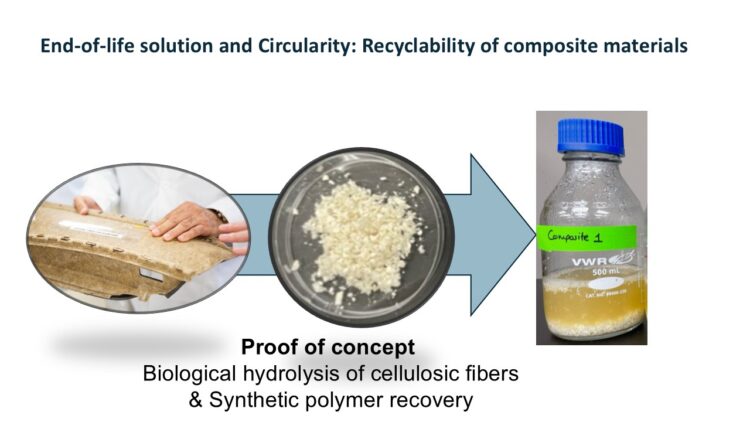
Bio-based composite materials offer a sustainable alternative to plastics; however, their end-of-life recyclability is an area of active research. Usually, these composites are degraded in landfills or incinerated, leading to loss of recyclability.
The Solution
Researchers at the Center for Renewable Carbon at the University of Tennessee have developed an enzymatic recycling method to break down natural fiber-petroleum composite materials. Natural fiber-petroleum composites are often made of cellulose fibers from plants and petroleum-derived polymers like polypropylene. This novel recycling method enables efficient recovery of virgin-like polypropylene while generating a sugar stream from the cellulose fibers that can also be commercially utilized. After exposure to the enzyme system under controlled conditions, sugar in the form of glucose is released into solution, while virgin-like polypropylene is recovered from the solid fraction by centrifugation or filtration. This enzymatic recycling method has been developed in a batch system with potential for adaptation to a continuous process for improved efficiency.
Benefits
| Benefit |
|---|
| End-of-life solution for natural fiber-synthetic polymers composite systems |
| Individual components of the composite can be recovered and re-used |
| Low-energy process to recycle natural fiber-synthetic polymers composite systems |
| Recovery of virgin-like recycled polypropylene |
More Information
- Rachel Valentine
- Assistant Technology Manager
- 865-974-4492 | rvalen18@tennessee.edu
- UTRF Reference ID: 25118
- Patent Status: Patent Pending
- Category: Chemistry & Materials
Innovators
Nicole Labbé

Institute Professor and Director, Center for Renewable Carbon, School of Natural Resources, UT Institute of Agriculture, UT Knoxville
Dr. Nicole (Niki) Labbé is a Professor of Biomass Chemistry and the Director of the Center for Renewable Carbon within the School of Natural Resources. Her research centers on understanding key biomass attributes including appearance, variability, and performance-relevant properties, and how these characteristics influence pathways to fuels, chemicals, and other value-added products. Her research ...
Dr. Nicole (Niki) Labbé is a Professor of Biomass Chemistry and the Director of the Center for Renewable Carbo...
David Harper
Professor, School of Natural Resources, UT Institute of Agriculture, UT Knoxville
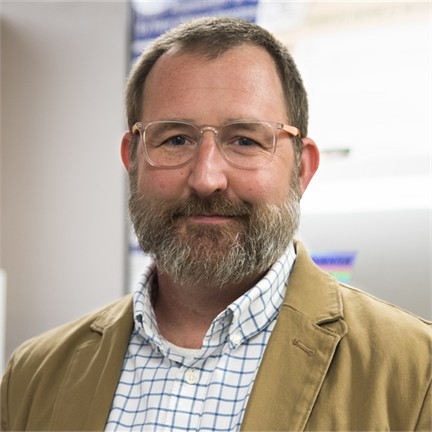
Dr. Harper received his PhD from Washington State University in 2003. He has a broad background in the manufacturing, designing, and characterization of natural composite materials. His formal training is in the design, manufacture, and mechanics of structural composite materials. Throughout his provisional career, his focus is on making new materials from renewable, plant-based sources. He has sp...
Dr. Harper received his PhD from Washington State University in 2003. He has a broad background in the manufac...
Anamika Missra

Single Quantum USA Inc
Dr. Anamika Missra received her PhD in Biochemistry, Molecular Biology and Microbiology from The Pennsylvania State University. Her postdoctoral research at the Center for Renewable Carbon at UTIA explored a biochemical approach for recycling natural fiber-based composites and microbiological pathways for valorizing underutilized biorefinery streams. She currently works at a scientific instrumenta...
Dr. Anamika Missra received her PhD in Biochemistry, Molecular Biology and Microbiology from The Pennsylvania ...