Embedded Electrospray Microthrusters for Adaptive Mission Profiles in Space
The Problem
As miniature ‘cubesat’ satellites have become more prominently used in scientific and commercial missions, so too has the need for deorbiting and reorienting propulsion systems for such cubesats increased. Electrospray thrusters (“ES Systems”) have emerged as a promising solution to this problem due to their compact nature and high specific impulse, though such systems often require expensive, complex fabrication processes and lack structural robustness.
The Solution
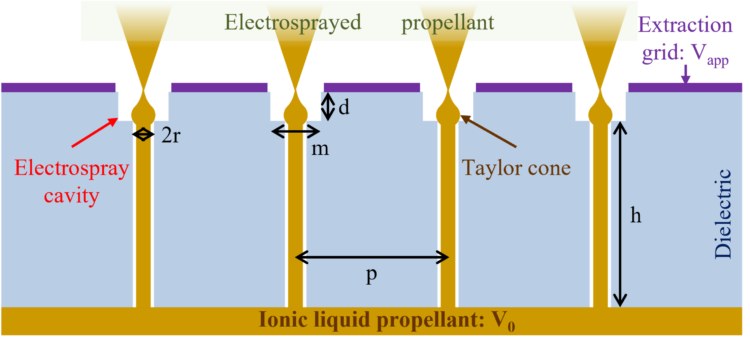
Researchers at the University of Tennessee have developed an ES thruster system which embeds open-ended microcapillaries inside a dielectric material, thereby protecting the emitters from degradation and providing an ultrasharp geometry which allows electrospray emission to occur at significantly lower operating voltages than conventional ES systems. The thrusters are fabricated using a fast, precise, and repeatable laser-micromachining process.
Benefits
| Benefit |
|---|
| Extends cubesat mission life and feasible mission objectives. |
| Use of electrically neutral ionic liquid means no charge mitigation measures necessary. |
| Bypasses need for complex lithography manufacturing techniques; laser micromachining enables 100x thrust density over state-of-the-art. |
| No external emitter projections which are subject to damage. |
| Design mitigates problems of backspray and overspray. |
More Information
- Gregory Sechrist
- Technology Manager
- 865-974-1669 | gsechris@tennessee.edu
- UTRF Reference ID: 21047
- Patent Status: US 12,523,200
- Category: Engineering
Innovators
Trevor Moeller

Graduate Programs Director and Jack D. Whitfield Professor, University of Tennessee Space Institute
Dr. Moeller received his PhD in Mechanical Engineering from The University of Tennessee in 1998. His research interests include electric propulsion devices, high-temperature gases, and electromagnetic acceleration. Dr. Moeller also leads the Computational and Experimental Aerospace Research Lab (CEAR), which is dedicated to the advancement of study in compressible and high temperature fluid dynami...
Dr. Moeller received his PhD in Mechanical Engineering from The University of Tennessee in 1998. His research ...
Brian K. Canfield

Research Scientist, Center for Laser Applications, University of Tennessee Space Institute
Dr. Canfield's work focuses on ultrafast laser micromachining, supported by broad expertise in linear and nonlinear optical measurement and diagnostics, including femtosecond laser machining, nonlinear optical and fluorescence microscopy, optical fibers, and mathematical modeling. He holds a Ph.D. in physics from Washington State University with a focus in nonlinear optics.
Dr. Canfield's work focuses on ultrafast laser micromachining, supported by broad expertise in linear and nonl...
Alexander Y. Terekhov

Manager of Research Engineering and Operations, University of Tennessee Space Institute
Mr. Terekhov brings extensive experience in laser-based microfabrication and precision research instrumentation, spanning ultrafast laser micromachining, direct-write patterning, microfluidic and lab-on-a-chip device fabrication, and thin-film and surface engineering for optical, materials, and biomedical applications. He also oversees research engineering and laboratory operations for the Institu...
Mr. Terekhov brings extensive experience in laser-based microfabrication and precision research instrumentatio...